


IAEA/USA Interregional course on
Preparations to Ship Spent Nuclear Fuel (1997)
Spent Fuel Classification Data
 PDF version available
DOWNLOAD full paper in PDF format.
Contact:
Dr. Raymond B. Pond
Physicist
Technology Development - 362
Argonne
National Laboratory
9700 South Cass Avenue
Argonne, IL 60439 USA
Phone: (630) 252-7090
Fax: (630) 252-5161

IAEA/USA Interregional Training Course
Technical and Administrative Preparations Required for Shipment of Research Reactor Spent
Fuel to its Country of Origin
13-24 January 1997
Argonne, IL
L.3.3
Spent Fuel Classification Data
R. B. Pond
RERTR Program
Argonne National Laboratory
Spent Research Reactor Fuel Assembly Properties
- Nuclear Mass Inventory: U, Np, Pu, Am
- Photon Dose Rate
- Thermal Decay Heat
Research Reactor Fuel Assembly Types
- MTR - fuel plates
- TRIGA - fuel rods
- DIDO - fuel annuli
Nuclear Mass Inventory
Mass Inventory: U, Np, Pu, Am
MTR-Type Fuel Assembly
- Initial U-235 enrichment: 20, 45, 93%
- Initial U-235 mass: 100 to 500g
- U-235 burnup: 5 to 80%
Mass Inventory: U, Np, Pu, Am
TRIGA-Type Fuel Assembly
- Single Rod
- Initial U-235 enrichment: 20 or 70%
- Initial U-235 mass: 38 to 133g
- U-235 burnup: 5 to 60%
- Rod Cluster
- Initial U-235 enrichment: 20 or 93%
- Initial U-235 mass: 41 or 54g
- U-235 burnup: 10 to 60%
Mass Inventory: U, Np, Pu, Am
DIDO-Type Fuel Assembly
- Initial U-235 enrichment: 20, 60, 80, 93%
- Initial U-235 mass: 150 or 200g
- U-235 burnup: 10 to 60%
Nuclear Mass Inventory Example
MTR-Type Fuel Assembly
| U-235 Mass, 300g | |||
| U-235 Burnup, 40% | |||
|
U-235 Enrichment |
|||
| Isotope | 20% | 45% | 93% |
| U-235 | 180 | 180 | 180 |
| U-236 | 20 | 19 | 19 |
| U-238 | 1205 | 361 | 22 |
| Np-237 | 0.4 | 0.4 | 0.4 |
| Pu-238 | 0.0 | 0.0 | 0.0 |
| Pu-239 | 7.5 | 3.4 | 0.4 |
| Pu-240 | 1.2 | 0.6 | 0.1 |
| Pu-241 | 0.4 | 0.2 | 0.0 |
| Pu-242 | 0.0 | 0.0 | 0.0 |
| Am-241 | 0.0 | 0.0 | 0.0 |
Photon Dose Rate
Photon Dose Rate Parameters
- Specific Fuel Assembly Power Density:
- 0.089 to 2.857 MW/kgU-235
- 0.089 to 2.857 MW/kgU-235
- U-235 Burnup: 20 to 80%
- Fission Product Decay Time: 2 to 20 years
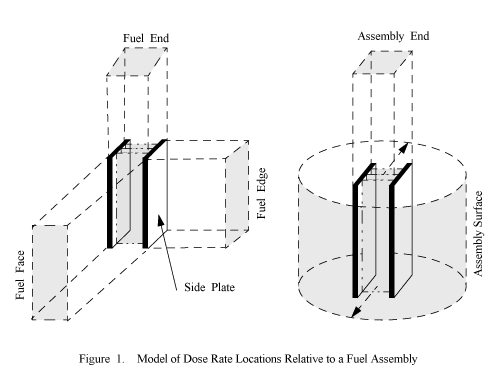
Photon Dose Rate Results at 1 m in Air
- MTR -
- TRIGA - 1.04 times MTR
- DIDO - 1.05 times MTR
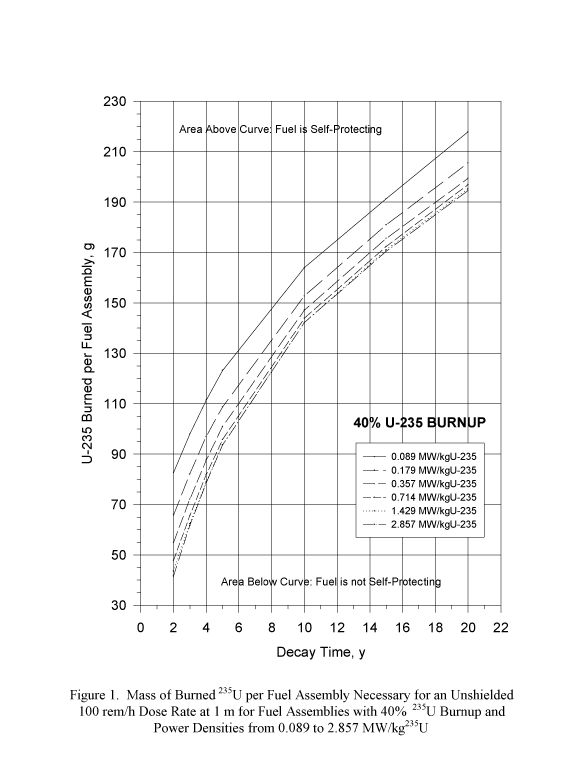
Photon Dose Rate Example
| Fuel Assembly Data | |
| Time-Average Power | 25 kW |
| U-235 Mass | 280 g |
| Specific Power Density | 0.089 MW/kgU-235 |
| U-235 Burned | 112 g |
| U-235 Burnup | 40% |
| Fission Product Decay Time | 3 y |
| Photon Dose Rate Results | |
| FP Dose Rate (Table 8) | 1.02 rem/h per gU-235 burned |
| FA Dose Rate at 1 m in Air | 114 rem/h |
| Self-Protection Time (Fig. 1) | 4 y |
Table 8. Photon Dose Rates At 1 M In Air,
rem/h per g 235U burned
| Decay Time, y | Burnup, %235U | Assembly Power Density, MW/kg 235U | |||||
| 2.857 | 1.429 | 0.714 | 0.357 | 0.179 | 0.089 | ||
|
2 3 4 |
1% |
1.84+0 1.13+0 9.01-1 |
1.84+0 1.13+0 9.01-1 |
1.83+0 1.13+0 9.01-1 |
1.80+0 1.13+0 9.01-1 |
1.77+0 1.11+0 9.01-1 |
1.70+0 1.11+0 8.92-1 |
|
2 3 4 |
10% |
1.89+0 1.19+0 9.52-1 |
1.87+0 1.20+0 9.61-1 |
1.80+0 1.20+0 9.61-1 |
1.64+0 1.16+0 9.44-1 |
1.50+0 1.09+0 9.10-1 |
1.28+0 9.95-1 8.59-1 |
|
2 3 4 5 10 15 20 |
20% |
2.01+0 1.31+0 1.04+0 8.97-1 6.67-1 5.78-1 5.10-1 |
1.98+0 1.32+0 1.05+0 9.10-1 6.67-1 5.78-1 5.10-1 |
1.86+0 1.28+0 1.04+0 9.05-1 6.67-1 5.74-1 5.10-1 |
1.66+0 1.21+0 9.99-1 8.80-1 6.59-1 5.70-1 5.06-1 |
1.42+0 1.11+0 9.44-1 8.46-1 6.50-1 5.61-1 4.97-1 |
1.19+0 9.78-1 8.63-1 7.95-1 6.25-1 5.44-1 4.85-1 |
|
2 3 4 5 10 15 20 |
40% |
2.40+0 1.62+0 1.27+0 1.07+0 7.03-1 5.87-1 5.14-1 |
2.30+0 1.60+0 1.27+0 1.07+0 7.03-1 5.84-1 5.12-1 |
2.09+0 1.53+0 1.22+0 1.04+0 6.95-1 5.80-1 5.08-1 |
1.82+0 1.39+0 1.14+0 9.90-1 6.80-1 5.70-1 5.02-1 |
1.52+0 1.22+0 1.03+0 9.20-1 6.55-1 5.53-1 4.87-1 |
1.21+0 1.02+0 8.99-1 8.12-1 6.10-1 5.23-1 4.59-1 |
|
2 3 4 5 10 15 20 |
60% |
2.95+0 2.05+0 1.59+0 1.30+0 7.55-1 5.96-1 5.17-1 |
2.79+0 2.00+0 1.56+0 1.29+0 7.51-1 5.96-1 5.17-1 |
2.52+0 1.87+0 1.49+0 1.24+0 7.37-1 5.88-1 5.13-1 |
2.15+0 1.66+0 1.35+0 1.15+0 7.07-1 5.72-1 4.99-1 |
1.74+0 1.40+0 1.17+0 1.02+0 6.70-1 5.50-1 4.76-1 |
1.34+0 1.12+0 9.63-1 8.54-1 6.02-1 5.04-1 4.39-1 |
|
2 3 4 5 10 15 20 |
80% |
3.85+0 2.73+0 2.08+0 1.66+0 8.28-1 6.18-1 5.27-1 |
3.62+0 2.64+0 2.03+0 1.63+0 8.21-1 6.15-1 5.20-1 |
3.26+0 2.43+0 1.90+0 1.54+0 8.00-1 6.05-1 5.13-1 |
2.76+0 2.11+0 1.69+0 1.39+0 7.59-1 5.82-1 4.97-1 |
2.21+0 1.74+0 1.41+0 1.19+0 6.97-1 5.44-1 4.66-1 |
1.64+0 1.33+0 1.12+0 9.57-1 6.04-1 4.87-1 4.20-1 |
Thermal Decay Heat
Thermal Decay Heat Parameters
- Fuel Assembly Time-Average Power
- Fuel Assembly Elapsed Irradiation Time
- Fission Product Decay Time
Thermal Decay Heat Example
| Fuel Assembly Data | |
Time-Average Power,  |
25,000 W |
| U-235 Mass |
280 g |
| U-235 Burnup |
40% |
U-235 Burned,  |
112 g |
| Fission Product Decay Time, td |
1095 d |
|
Elapsed Irradiation Time, te where |
3584 d |
| Thermal Decay Heat Results | |
| ORIGEN |
4.2 W |
Eq. -1: Integrated Emission Rates  |
|
Eq. -2: El-Wakil  |
|
Eq. -3: Untermyer and Weills   |
|


Figure 2. Comparison of Decay Heat Equations-2 and -3 with ORIGEN
PHDOSE Program Package
- Example Input
- Example Output
- Input/Output Description
- PHDOSE Program (Fortran)
PHDOSE Program
- Dose Rate: Line-Source Model of Spent Fuel
- MTR ~ 0.92 times L-S Dose Rate
- TRIGA ~ 1.04 times MTR Dose Rate
- DIDO ~ 1.05 times MTR Dose Rate
- Fission Product Radioactivity (Curies)
- Photon Source (Ph/s)
- Gamma Decay Heat (Watts)
PHDOSE Fission Products
Sr-90, Y-90, Cs-133, Cs-134

Cs-137, Ba-137m, Ce-144, Pr-144

Ru-106, Rh-106, Zr-95, Nb-95
SUMMARY
- Nuclear Mass Inventory
- Obtain by Table Look-up
- Obtain by Table Look-up
- Photon Dose Rate
- Obtain by Table Look-up
- or PHDOSE Program
- Thermal Decay Heat
- Obtain by Analytical Expression





 Denotes links opening in a new browser window

